From office removals to complex commercial relocation projects, Bishop’s Move manages business relocations across the UK, delivering every move on time, within budget and with minimal disruption.
Whether you’re moving to Bern, Geneva, Zurich or a little village in the middle of the Swiss Alps, discover everything you need to know about moving to Switzerland from the UK in our guide.
Moving abroad can seem a daunting prospect, which is why taking time to plan and research beforehand is highly advised. As a leader in European removals, we have the necessary expertise to help provide you with as much information as you need, so you can better understand what to expect before your moving day.
Moving to Switzerland?
Quick Guide to Moving to Switzerland
UK citizens need a Swiss residence permit to live and work in Switzerland.
Switzerland is one of Europe’s most expensive countries, but salaries are proportionally high, with average gross annual salaries exceeding CHF 80,000 (£76,336) in many sectors.
Switzerland has four official languages (German, French, Italian, Romansh), with English widely spoken in business settings in Zurich and Geneva.
Bishop’s Move offers fully tailored Swiss removals packages including professional packing, road freight and optional storage — get a quote today.
Why Move to Switzerland?
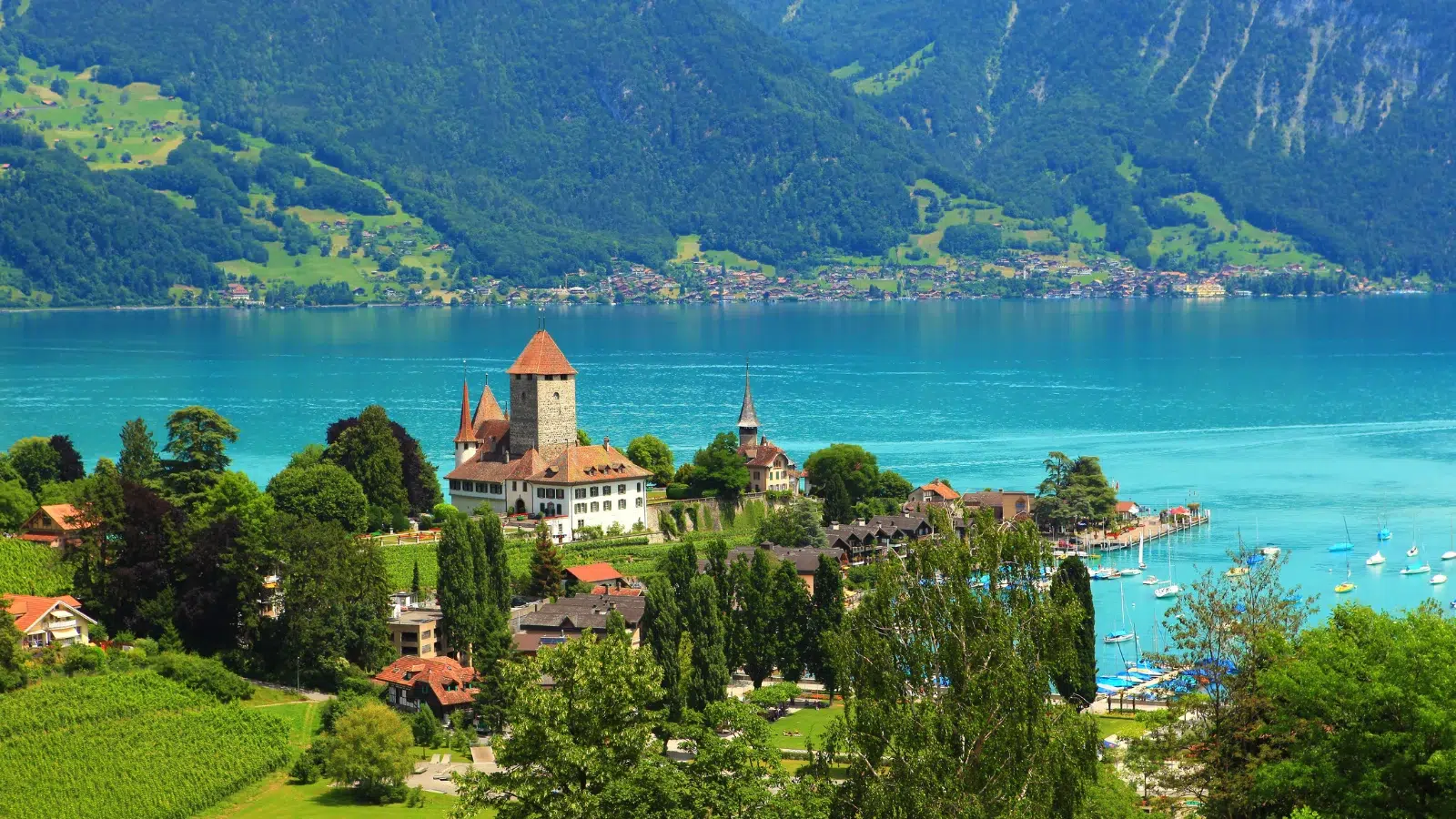
Switzerland, famous for its dramatic snow-capped mountains and charming blue lakes, is an ideal destination for those seeking a new and improved lifestyle. Sitting in central Europe, Switzerland is very well-developed and has the world’s most advanced free-market economy. This makes the country an attractive option if you wish to advance your career, as salaries can be nearly triple those of other European countries. Education is also highly advanced here, and with plenty of international schools to choose from, children receive an excellent education through the strict schooling system currently in place.
Many may also move to Switzerland to enjoy the serenity of the Swiss Alps, which boast immense natural beauty. Adventure-seeking skiers often decide to reside here, with the region offering world-renowned ski resorts with unmatched views of the mountains.
Beyond the scenic beauty, Switzerland consistently ranks among the top countries in the world for quality of life, safety, and political stability — making it a compelling destination for professionals, retirees and families alike. The Swiss public transport network is world-class, healthcare is excellent, and crime rates are very low.
Visas & Residency Requirements: What UK Citizens Need to Know
Since Brexit, UK citizens no longer benefit from EU freedom of movement. This means that if you want to live and work in Switzerland, you must apply for the appropriate residence permit before or immediately upon arrival.
Types of Swiss Residence Permits:
B Permit (Residence Permit): For those moving to Switzerland with a confirmed job offer or to join a Swiss-resident family member. Valid for 1–2 years and renewable. This is the most common permit for UK expats.
L Permit (Short-Term Permit): For stays of less than 12 months, typically for fixed-term contracts.
C Permit (Settlement Permit): Permanent residence permit. You can apply after 5 or 10 continuous years of legal residency, depending on your nationality and circumstances.
It is strongly recommended to begin the visa and permit process at least 3 months before your planned move date, particularly if you need to arrange accommodation and a job offer in Switzerland simultaneously.
Culture in Switzerland
Swiss culture is very diverse, and with the country being bordered by five other countries, culture can be influenced by Italy, Austria, Germany, France and the Principality of Liechtenstein. An example of this influence can be seen in the language, with national dialects including German, Italian, French and Romansh. Most notably, Switzerland is well-known for its strong mountaineering and skiing culture, with the Alps consuming 58% of the Swiss land. Around 35% of the population ski regularly, which is a very high figure when compared to other European countries.
Swiss cuisine is diverse, with each region known for its own specialities. Different foods may also be consumed depending on the time of year; for example, fondue and raclette, two famous melted cheese dishes, will be more commonly eaten during the frosty winter months. Switzerland also has a reputation for its high-quality chocolates, with world-renowned brands such as Lindt and Toblerone originating there.
Socially, the Swiss are known for punctuality, privacy, and a strong community spirit. Neighbours often play an important role in local life, and learning even basic phrases in the local language goes a long way in building rapport. Sundays are generally quiet — many shops close and noise restrictions apply — so plan accordingly.
Cost of Living in Switzerland
Switzerland is consistently ranked as one of the most expensive countries in Europe, but this is offset by correspondingly high salaries and excellent public services. Here is a realistic overview of monthly costs:
Rent: CHF 1,500–3,000 (£1,430-2,868) per month for a one-bedroom apartment in a city centre (Zurich and Geneva are the most expensive)
Groceries: Budget CHF 400–700 (£382-669) per month for a single person; Swiss supermarkets Migros and Coop are more affordable than specialist stores
Compulsory health insurance (Krankenkasse): Approximately CHF 300–500 (£286-478) per month per adult — this is mandatory for all residents.
Public transport: A nationwide GA (General Abonnement) travel pass costs around CHF 3,860 (£3,690) per year and gives unlimited train/bus/tram travel
Dining out: Expect to pay CHF 20–40 (£19-38) for a main course at a mid-range restaurant
Average gross salaries in Switzerland are among the highest in the world — CHF 80,000–120,000 (£76,483-114,725) per year is typical in sectors like finance, pharma, and technology. This helps offset the significantly higher cost of living compared to the UK.
Healthcare in Switzerland
Switzerland has a universal healthcare system, which is regulated through the Swiss Federal Law, meaning that everyone has access to the services on offer. Despite this, healthcare is not free and must be paid for privately by all residents, including nationals and expats. However, the medical services provided are of excellent quality, and there are minimal waiting lists and well-equipped facilities to cater for your needs.
Within 3 months of arriving in Switzerland, you are legally required to register with a Swiss health insurance provider (Krankenkasse). Premiums vary depending on your chosen provider, the level of excess (franchise) you select, and the canton you live in. You can compare providers and premiums using the official Swiss government comparison tool at Comparis.ch.
As a UK expat, your NHS entitlement does not apply in Switzerland. Ensure you register with a Swiss GP (Hausarzt) promptly after arrival — in Switzerland, your GP acts as a gatekeeper to specialist care.
Working in Switzerland
If you are a career-oriented individual seeking a good work-life balance, Switzerland is the place for you. A large portion of Switzerland’s workforce is made up of foreign employees, and there are strong laws in place to protect worker rights. The country has a very skilled labour force, with key emerging industries including mechanical and electrical engineering, pharma, banking, finance and insurance.
When applying for a job in Switzerland, you will need a CV, a cover letter and education certificates. To work in Switzerland, you must apply for a residence permit from the Swiss commune. To obtain the permit, you must submit a valid ID card or passport, confirmation of employment from your employer or your contract.
Swiss working culture tends to value precision, professionalism and punctuality. A strong command of the regional language (German, French or Italian) is increasingly expected for many roles, though international companies in Zurich and Geneva often operate in English. Average working hours are around 41–42 hours per week, and a minimum of 4 weeks’ annual holiday is legally guaranteed.
Education & Schools in Switzerland
Switzerland has an excellent education system across public, private, and international options, making it a popular destination for families relocating from the UK.
Public Schools:
State schooling is free and of very high quality, but lessons are taught in the local cantonal language (German, French or Italian). Children are expected to integrate linguistically, so language support and a settling-in period are important to plan for.
International Schools:
Switzerland is home to some of the world’s most prestigious international schools, particularly in Zurich, Geneva, Lausanne, and Lugano. Many follow the International Baccalaureate (IB) curriculum and teach in English. Fees range from CHF 15,000–40,000+ (£14,330-38,241) per year per child, so factor this into your relocation budget.
Key Tip:
International school waiting lists in Zurich and Geneva can be long — begin enquiries 6–12 months before your planned move date if an English-medium education is a priority for your family.
Getting Around Switzerland
Switzerland is world-famous for its efficient, reliable and beautiful public transport network. The Swiss Federal Railways (SBB) connects virtually every town and village, with trains running on time to the minute.
The GA (General Abonnement) travel card offers unlimited travel on trains, buses and trams across Switzerland — an excellent investment for daily commuters
Zurich and Geneva have excellent tram and bus networks within the city
Driving is on the right-hand side (opposite to the UK). Your UK driving licence is valid for 12 months after taking up Swiss residence, after which you must convert it to a Swiss licence
Switzerland requires a motorway vignette (CHF 40/£38 per year sticker) to legally drive on Swiss motorways — available at border crossings, petrol stations, and post offices
Cycling infrastructure is excellent in most Swiss cities, making it a practical daily transport option
Living in Switzerland: Top Destinations for Expats
Ahead of your move, we’d highly recommend taking a look at the various areas on offer. Each location can vary in price, lifestyle, housing, schooling and much more. Here are just some of the top destinations in Switzerland that expats choose to move to each year.
Zurich
Home to the largest expat community in Switzerland, Zurich is the country’s economic powerhouse and largest city. This German-speaking city is well-equipped with excellent transport links, as well as great local bars, restaurants and shops. In Zurich, the booming city lifestyle pairs beautifully with picture-perfect Swiss lake views.
Zurich is consistently ranked the world’s most liveable city. It is home to a large international finance and technology sector, making it the top choice for career-driven UK expats. Note that it is also the most expensive city in Switzerland — budget accordingly.
Geneva
Stretched alongside the famous Lake Geneva, the French-speaking city of Geneva is home to some of the world’s biggest organisations, such as the United Nations and the World Health Organisation. The lifestyle here is fairly laid back, with well-preserved walks and scenic routes to enjoy. The city is also a short drive away from some of Europe’s best ski resorts.
Geneva attracts a large international community thanks to its concentration of NGOs, diplomatic missions, and global organisations. French is the dominant language, and the city has a cosmopolitan feel with world-class restaurants, museums, and cultural events.
Bern
The capital city, Bern, has an incredible alpine scenery, which is popular with relocating families. Residents benefit from excellent schools, first-class sporting activities and plentiful employment opportunities.
Bern is more affordable than Zurich or Geneva, yet it still offers an excellent quality of life. Its charming medieval old town is a UNESCO World Heritage Site, and the city has a slower pace that appeals to families and those leaving behind the hustle of larger UK cities.
Why Choose Bishop’s Move for Your Swiss Relocation?
Have we convinced you to move to Switzerland? With unmatched employment opportunities and a wide array of outdoor activities to enjoy, Switzerland has it all. At Bishop’s Move, we’re a leader in European removals and can provide you with a Swiss removals package tailored to suit your individual needs.
Here’s what sets Bishop’s Move apart:
Over 170 years of removals experience — we’ve been helping families move across Europe and beyond for generations
Fully tailored Swiss removals packages — we don’t do one-size-fits-all; every quote is bespoke to your home and circumstances
Professional packing services to protect your most valuable belongings on long-distance moves
Optional short and long-term storage solutions if there’s a gap between your UK departure and Swiss arrival
Dedicated move coordinator who will guide you from survey to delivery — a single point of contact throughout
Full insurance options for complete peace of mind during your international move
We consider everything from packing to storage and will work with you to ensure that your move is seamless. Find out more about removals to Switzerland or get in touch with your local branch to discuss your options.
Do UK citizens need a visa to move to Switzerland?
Yes. Since Brexit, UK citizens no longer benefit from EU freedom of movement. To live and work in Switzerland, you must apply for the correct residence permit — typically a B Permit (short-term) or C Permit (long-term/permanent). The type required depends on your employment status and how long you intend to stay.
How much does it cost to live in Switzerland?
Switzerland is consistently ranked among the most expensive countries in the world. A single person can expect to spend between CHF 3,500–5,000 (£3,346-4,780) per month on living costs, including rent, food, transport and healthcare insurance. A family of four should budget CHF 7,000–10,000 (£6,692-9,560) per month. However, Swiss salaries are correspondingly high, often exceeding CHF 80,000–120,000 (£76,483-114,725) per year gross, depending on the sector.
How do I find housing when moving to Switzerland from the UK?
The Swiss rental market is competitive, particularly in major cities like Zurich and Geneva. Start your search on platforms such as Homegate.ch, Comparis.ch, and Immoscout24.ch. You will typically need to provide proof of income, a reference from a previous landlord, and a copy of your residence permit or work contract. Renting short-term serviced accommodation initially can give you time to explore neighbourhoods before committing.
How long does it take to ship belongings from the UK to Switzerland?
A professional removal service like Bishop’s Move typically completes road freight from the UK to Switzerland within a week, depending on your exact addresses. For a full household shipment, the removal process from packing to delivery usually takes 1–2 weeks in total. We recommend booking your removal at least 6–8 weeks before your move date to ensure availability and allow time for customs preparation.
Is Switzerland expensive compared to the UK?
Yes, Switzerland is significantly more expensive than the UK in most categories. Grocery shopping costs roughly 60–70% more, restaurant meals are around 50% pricier, and average rent in cities like Zurich can be two to three times higher than equivalent UK cities. However, Swiss salaries are much higher to compensate, and residents benefit from excellent public services, clean infrastructure, and a very high quality of life.
Do I need to speak German, French or Italian to live in Switzerland?
While English is widely spoken in business environments and major cities, learning the local language of your region (German in Zurich, French in Geneva, Italian in Lugano) will significantly help your integration. Many Swiss employers expect working knowledge of the local language for customer-facing or administrative roles. Language schools are readily available, and many larger companies offer integration language courses for international hires.
Ready to Make Your Move to Switzerland?
Moving to Switzerland is an exciting milestone — and with the right removal partner by your side, the process doesn’t have to be stressful. Bishop’s Move has been helping families relocate across Europe for over 170 years, and our dedicated Swiss removals team is ready to help make your move seamless.
Get your free, no-obligation Switzerland removals quote today and take the first step towards your new Swiss adventure.